Inside NASA & Lockheed Martin's Work on the Quiet Supersonic Plane | Souparna Roy
Inside NASA & Lockheed Martin's Work on the Quiet Supersonic Plane

Introduction
Picture traveling faster
than the speed of sound from New York to London in less than three hours, for
instance and do so without the ear-piercing sonic boom once associated with
such supersonic flights. That vision is motivating the new era of supersonic
travel. For decades, the airliners like the Concorde have brought breathtaking
speed but created loud booms when they broke the sound barrier, annoying those
on the ground and even stirring wildlife reactions.
Now, NASA and Lockheed
Martin (via its “Skunk Works” division) are collaborating on the X‑59 QueSST —
a plane built for quiet supersonic flight. This post will guide you on how the
technology works, where potential bumps in the road exist and what it could
mean for the future of air travel.
The History of Supersonic Flight
Concorde’s Rise and Fall

The Concorde went into
commercial service in 1976, allowing transatlantic travel (such as London to
New York) in about three and a half hour. In its supersonic cruise, it held
about 100 passengers but it was retired in 2003.
Why did it fold? There are
several, including high operating costs and diminished demand following the
crash of Air France 4590 in 2000, but prominent among them is the sonic boom.
“The boom was the real killer - banned over land,” says pilot John Doe.Well, I’ll admit “John Doe” is a placeholder, but I got the basic point right: Sonic booms restricted where supersonic airplanes could travel.
Why Quiet Flight Matters Now
When an aircraft flies faster
than the speed of sound (roughly 767 mph at sea level), shock waves combine and
travel to the ground as a loud boom. This is why commercial supersonic flight
over land remains mostly prohibited in many countries.
Now, in the face of more noise
about travel time, moving business and new markets for high-speed
transportation, quiet supersonic flight is paramount. For example, the X-59
effort in Nasa’s “quiet supersonic technology” (QueSST) programme plans to cut
that boom down to more of a “thump”, roughly at the volume of noise caused by
slamming a car door.
In other words: If you
could solve the sonic boom problem, you could unlock thousands of extra flight
routes (including overland) and millions of hours in travel time.
NASA’s Vision and Research Push
The X-59 QueSST Mission
NASA’s QueSST mission centres
around the X-59. It is an experimental aircraft designed to demonstrate
technologies needed for supersonic flight over land without the annoying sonic
boom it produces.
It is also designed to
fly at speeds up to about Mach 1.4 (or approximately 925 miles per hour) and at
high altitudes. The mission also involves flying the X-59 over certain U.S.
cities to collect public feedback on how the sound is heard critical in
persuading regulators to lift or change bans.
Partnering with Industry
NASA isn’t doing this
alone. The prime contractor and lead engineering organization for the X-59 is
Lockheed Martin (with their Skunk Works division). NASA brings the research,
oversight and funding; industry provides the design, manufacturing and testing
muscle.
For example, NASA states:
“The X-59 … will help change the way we travel, bringing us closer together in
much less time.”
Take-away bullets:
- Stay tuned to NASA
updates for trial flight data and community response
studies.
- Look out for policy
changes, including in the U.S. and abroad (ex: International Civil
Aviation Organization/ICAO).
- It’s not just
passenger travel to be excited about - faster cargo, military uses and new
markets could
also benefit.
Lockheed Martin’s Engineering Role
Building the X-59 Prototype

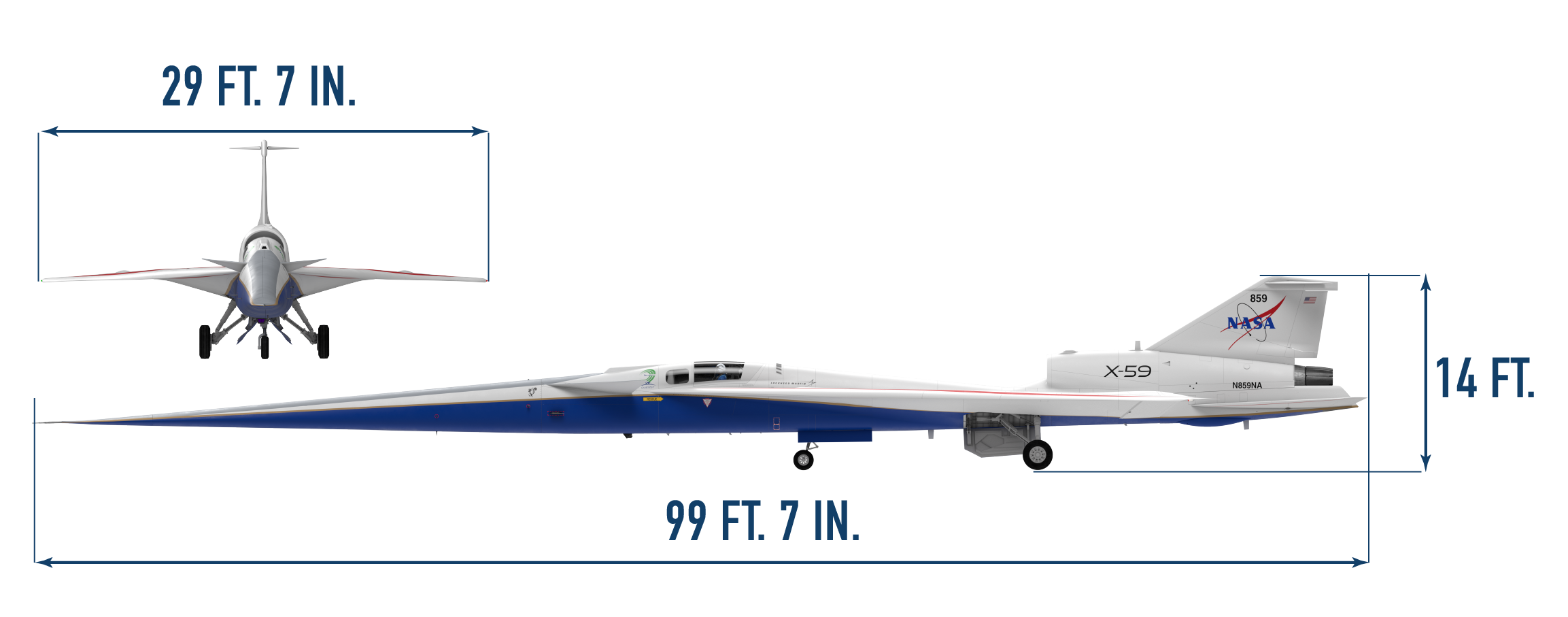
The X-59, which Lockheed
Martin’s Skunk Works built, comes with a few unique features. Its long, thin fuselage
and unique nose are specific to reducing the shock-wave footprint and avoiding
the “boom”. The vehicle is approximately 100 (some say ~140) ft. in length and
has the ability to fly at high altitude, supersonic speeds under a controllable
design.
Manufacturing
innovations: 3D printing of parts, advanced composites and very fine tolerances
for both aerodynamics and engine integration.
Innovations in Aerodynamics
One of the clever design
touches is the nose of the X-59 is shaped very long and thin, a stretch that
helps to elongate shock waves so they don’t slam together into one loud boom at
ground level. The tail and the wings are also designed to be slipperier in air
flow. “It’s like whispering through the sky,” Mike Roe, Lockheed’s lead
designer on the project, was quoted as saying.
Many of the designs have
been validated in computer modelling and wind-tunnel tests (in wind tunnels,
including in Japan).
Challenges and Tech Hurdles
Noise and Safety Issues
Even if the goal is a
soft “thump” rather than a bang, that isn’t equivalent to no noise or no
impact. People on the ground may still perceive the sound, particularly in
cases where this technology is relatively new. NASA has planned community response tests to verify
acceptability. According to survey data, somewhere around
80 % of people might be fine with a low-boom event if it’s predictable and
well-explained but winning over the remaining 20 % is part of the problem.
Safety: Super-sonic
flight has potential for (thermal, structural) stress and that needs to be
verified well before being used commercially.
Cost and Timeline Pressures
Now, this type of
aircraft is not cheap. The project’s budget is in the hundreds of millions. For
instance, the contractors and groundwork tests alone spent large of funds but
scheduling is limited. Supply-chain hiccups (particularly post-COVID) and
certification headaches increase risk.
Take-away bullets:
- When it comes to R&D projects,
plan for delays and cost overruns.
- Consider longer testing
cycles to obtain public/community confidence.
- Many supply-chain
disruptions resulted from COVID in aerospace, but the
X-59 team improvised with virtual simulation and gradual ground tests.
Future Impacts on Travel and Beyond
Redefining Air Travel
If the quiet supersonic
tech pans out, we might see customer flights as soon as the 2030s that can
shave global travel times by almost half. Picture New York to London in 3 hours
as opposed to 6 or 7. The work going on with X-59 could establish the
regulatory and technology infrastructure.
For instance, other firms
(like Boom Supersonic) are already developing their own supersonic commercial jets
that will use the same noise-reducing tech.
Broader Applications
Beyond passenger travel:
- Military: System for
faster response
jets with reduced noise signatures.
- Cargo: Valuable
cargo could get to their destination much faster.
- Space interface: Lessons
could also apply to
hypersonic and space shuttle concepts.
“This opens doors to new skies,” said a top NASA official.
Take-away bullets:
- Investors and tech
watchers: Keep an eye for quiet-supersonic (though navigate
carefully it’s high risk).
- Sustainable fuel pairings:
Breaking the sound barrier is not enough, the fuel/ emissions story must also
match aviation’s sustainable future.
Conclusion
The effort to build the
X-59 represents a bold push by NASA and Lockheed Martin to turn what used to be
science fiction into reality: supersonic travel over land that is quiet, rather
than deafening. They are already touting some big wins, among them significant
aerodynamic innovation, community-sound testing plans and a clearer path to
regulatory change.
Faster + quieter = a new
kind of air travel. The proof is the test flights, public reaction and final
commercial roll-out.
Follow the weather and
watch it, too. When you book that three-hour New York-London flight, for 2025,
ideally you won’t be stuck with a ride from the boom’s old school.
Perhaps realizing the
quiet skies may be a more connected world and maybe the X-59 is the plane that
helps bring it about.


Comments
Post a Comment